ANTIMONY SPECIATION
Although it has been used in medicine by man for several thousand years, antimony is found to be non-essential and toxic to human body. However, the toxicity of antimony is also expected to be specie and form dependent. Elemental antimony is more toxic than its salt, and trivalent Sb is generally ten times more toxic than pentavalent Sb species. Antimony trioxide is found to cause serious lung cancer by inhalation. Whereas some antimony containing salts are commonly used as therapeutic treatment of parasite such as leishmaniasis. The concentration and more importantly the speciation of antimony must be understood before its toxicity can be assessed. As well as it's own 10.820 Modular Interface, P S Analytical offer both Agilent and Dionex options for the separation of antimony species using the PSA 10.055 Millennium Excalibur as the detector. PSA 10.820 MODULAR INTERFACE COUPLED WITH THE 10.055 MILLENNIUM EXCALIBUR FOR THE SPECIATION OF ANTIMONYThe separation of SbIII and SbV can be carried out in less than 3 minutes using a simple isocratic elution program and a strong anion exchange column (PSA C1 or equivalent). The system offers reliability and ease-of-use and gives limits of detection of 0.2 ng ml-1, making it a useful tool for any laboratory interested in antimony speciation. |
|
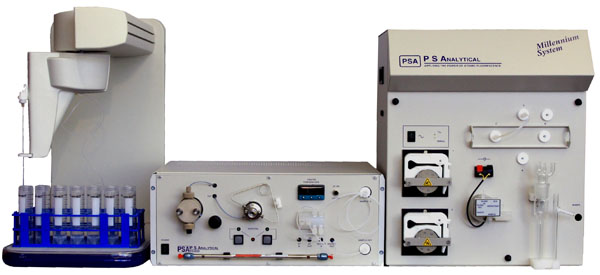 |
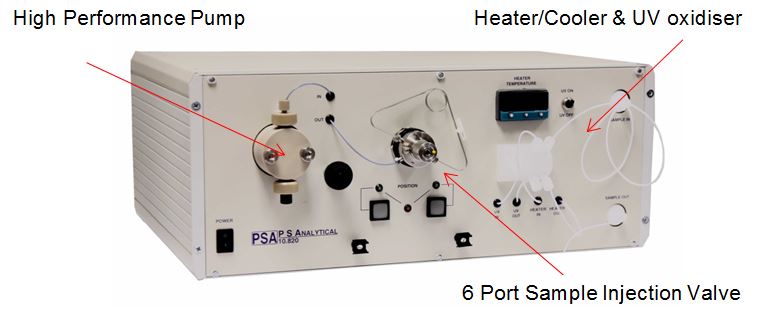
The MI extends the capability of P S Analytical's Millennium Merlin and Excalibur Atomic Fluorescence Spectrometers and is available in a number of configurations. The MI 10.820-1000 includes:
|
With a simple interface, and compatible flow rates, the accessory facilitates speciation studies (Hg, As, Se, Sb, Bi etc), online digestion (heat and UV), as well as a variety of post column reactions. The conjunction of the AFS systems with the MI provides ultimate detection performance for both sensitivity and selectivity. In addition to the impressive detection performance, the automated approach significantly speeds up analysis times, reduces and sample pre-treatment and handling errors. |
 |
|
All of these systems provide arsenic speciation for labs that need an easy-to-learn and easy-to-use system, which can be automated and/or extended as the labs needs grow. |
||
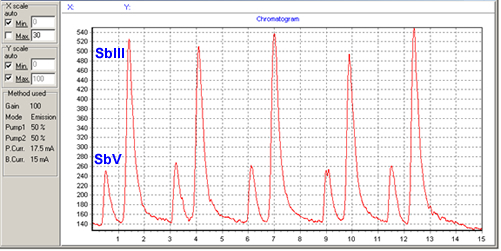
Chromatogram of Five Consecutive Injection of 5 ng ml-1 Antimony StandardsThe chromatogram below shows consecutive injections of 5 ng ml-1 mixed standards of Sb (V) and Sb (III). |
 |
|
Species in real samples are identified on the basis of their retention times. Precision for the two species is below 5% RSD, and limits of detection for Sb (V) and Sb (III) are in the order of 0.7 and 0.5 ng ml-1, respectively. To discuss particular requirements and for more detailed information on the above products please complete the Information Request Form. For information on the speciation of Mercury, Arsenic and Selenium please follow the appropriate link below: |
|
|
|
|